

Marie Jacobs
Bio
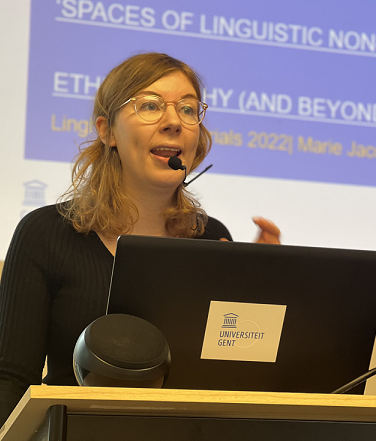
Marie Jacobs (she/her) is a post-doctoral researcher in the field of sociolinguistics, supported by scholarships from the National Fund for Scientific Research and the Research Foundation Flanders. She is affiliated with the Department of Languages and Literatures at the Université Libre de Bruxelles and the Department of Translation, Interpreting and Communication at Ghent University. Her PhD dissertation presented a linguistic ethnography of immigration law firms and investigated the role of language, narratives, and multilingualism in legal assistance for asylum seekers in Belgium. Her current work investigates language policies and the organization of language support in migration contexts. She is also interested in the methodological challenges of conducting research in superdiverse and sensitive environments. Marie Jacobs has published in esteemed international journals such as Language in Society, Journal of Pragmatics and Language Policy and has contributed to edited volumes such as The Routledge Handbook of Multilingualism and Handbook of Pragmatics. She is also the co-editor of a special issue on “Spaces of Linguistic Non-Understanding when Researching Multilingually,” which appeared in Multilingua earlier this year.
Navigating Multilingual Complexities in the Asylum Context: Disparities, Practices, and Research Reflections
Applying for asylum is not merely a legal procedure—it is fundamentally a multilingual and discursive process. My research starts from the observation that communication in the asylum process is marked by a profound disparity in linguistic resources. Asylum seekers possess diverse language repertoires shaped by their biographical trajectories, while professionals who work in the asylum context, such as asylum officers and legal representatives, primarily operate in the host country’s dominant languages. This linguistic asymmetry necessitates multilingual strategies to facilitate asylum interaction: encounters are often mediated by (in)formal interpreters or conducted in a lingua franca.
This talk examines how managing the multilingual complexity of asylum interactions entails significant challenges for asylum officials, who decide who is granted asylum based on oral testimonies, for lawyers who navigate multilingual counsel, and for language scholars who study communication in the asylum procedure. To address this, I triangulate findings from three research projects in the Belgian context: an institutional discourse analysis of migration law and asylum decisions, a linguistic ethnography of lawyer-client interaction in immigration law firms, and methodological reflections on researching multilingually. Through the integration of these studies, I reveal the diverging multilingual strategies employed in the asylum process and how they constrain asylum seekers' opportunities to have their voices heard. Reflecting on my own experiences of conducting research in a multilingual context, I conclude that this linguistic inequality is the product of institutional limitations and context-bound ideologies rather than professional ignorance. In light of this finding, I propose two key methodological recommendations for the future of bilingualism studies.