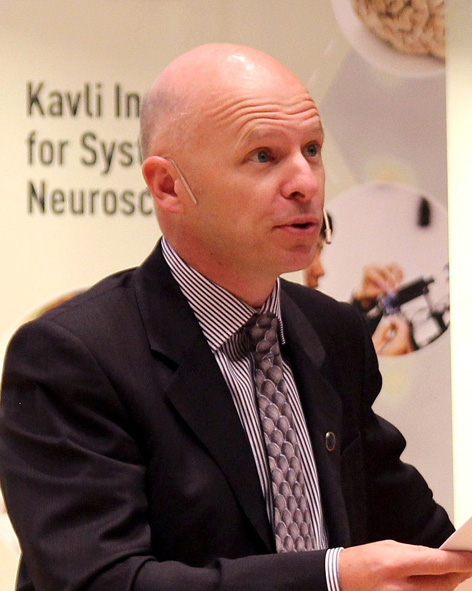
Stanislas Dehaene
Collège de France
The quest for the neural code for written words
Thanks to a series of in-silico, behavioral, brain-imaging and electrophysiological experiments, we begin to understand what happens in the brain during the acquisition of reading. Recent computational modeling studies suggest a new hypothesis about the neural code for invariant recognition of written words: with training, neurons that we call “space bigrams” become tuned to a letter at a fixed approximate position relative to the beginning or the end of the word. I will present new brain-imaging data, as well as single-cell recordings in humans and even in monkeys, which supports the existence of such a neural code in the visual word form area of left ventral inferotemporal cortex. I will then describe how those findings shed new light on the various types of dyslexias and their diagnosis. I will end with a discussion of how this scientific understanding of reading can be applied in the classroom, as we do with our non-profit reading method Kalulu (https://kalulu.excellolab.org/).