 Eventos pasados: More than 100 scientific works will be showcased at IWORDD 2026
- The program includes oral and poster sessions, four keynote lectures, two symposiums and a day open to educators and other professionals.
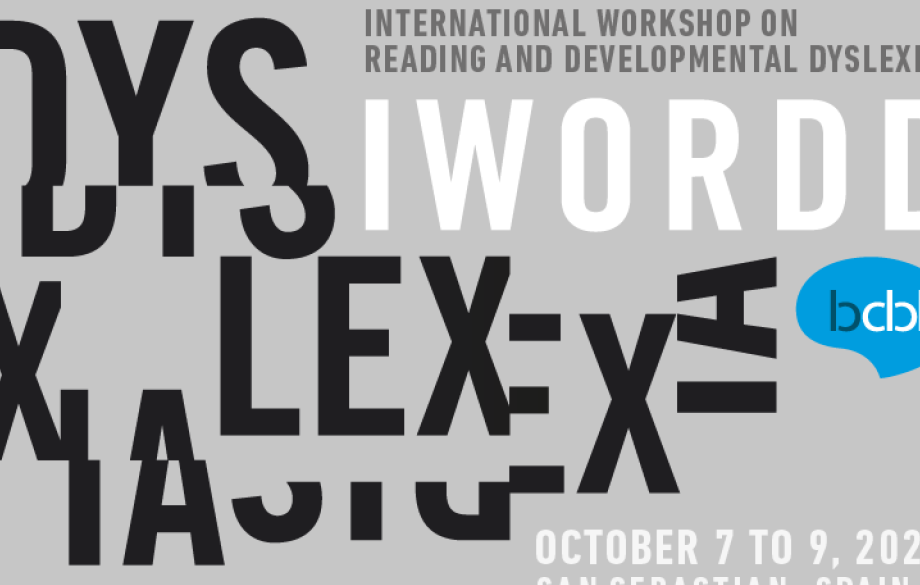
The International Workshop on Reading and Developmental Dyslexia (IWORDD) continues with the preparations of the next edition, scheduled between October 7 and 9 in San Sebastián (Gipuzkoa, Spain). The scientific forum organised by the Basque Center on Cognition, Brain and Language (BCBL) has released the full program with more than 100 works to be showcased during the academic sessions.
The first two days of IWORDD 2026 will be devoted to scientific discussion among scientists, psychologists and other international experts in the field of reading and developmental dyslexia.
Among the different poster and oral sessions that are scheduled for the congress, there are 6 interventions to be highlighted: four keynote lectures and two symposiums.
Keynote lectures
- Prof. Nadine Gaab (October 7, 9:00-10:00): She leads Gaab Lab at the Harvard Graduate School of Education. Gaab’s talk will focus on learning differences in reading acquisition, presenting results from longitudinal behavioral and neuroimaging studies that characterize differences in learning to read as a complex outcome, within an early multifactorial framework. The implications of these findings for contemporary challenges in educational, clinical, and policy practice will also be discussed.
- Prof. Stanislas Dehaene (October 7, 17:00-18:00): Professor at Collège de France, he is the co-founder of Excello, an association located at the interface between research and practical educational applications to provide teachers with comprehensive and scientifically validated solutions. At IWORDD he will present new brain-imaging data, as well as single-cell recordings in humans and even in monkeys, which supports the existence of a neural code for invariant recognition of written words in the visual word form area of left ventral inferotemporal cortex. He will then describe how those findings shed new light on the various types of dyslexias and their diagnosis.
- Prof. Michelle Luciano (October 8, 9:00-10:00): Professor at the University of Edinburgh, she will provide an overview of the latest findings on common genetic variants in the population involved in reading development and dyslexia, and how these studies can inform our understanding of genetic overlap with related cognitive processes and traits.
- Associate Prof. Jason Yeatman (October 8, 17:00-18:00): Associate Professor at Stanford University, he will present a new framework for considering the balance between stability and plasticity in the developing brain and its implications for learning disabilities like dyslexia, based on long-term educational intervention studies on dyslexia.
Symposiums
- “Bridging Neurogenetic and Behavioural Research: Possible Implications for Language and Reading Interventions” (October 7, 12:00-13:20). Dr. Monica Melby-Lervåg, Professor at University of Oslo, will be the Chair of the first invited symposium.
- “Gene-environment interplay on reading and dyslexia” (October 8, 10:00-11:20). Dr. Franck Ramus, Senior Research Scientist at the Laboratoire de Sciences Cognitives et Psycholinguistique, will be the Chair of the second invited symposium.
From theory to practice
IWORDD 2026 will finish on October 9 with “From theory to practice”, a special day to promote the transfer of knowledge and interaction among researchers, parents, teachers and practitioners. It is centered around keynote lectures by international experts tailored to a broad audience, followed by a round-table discussion. For this part of the workshop, simultaneous interpretation in Spanish, English and Basque will be provided.
- Socios

- Promotor

- Orgullosos de ser


© 2026 BCBL Reservados todos los derechos
